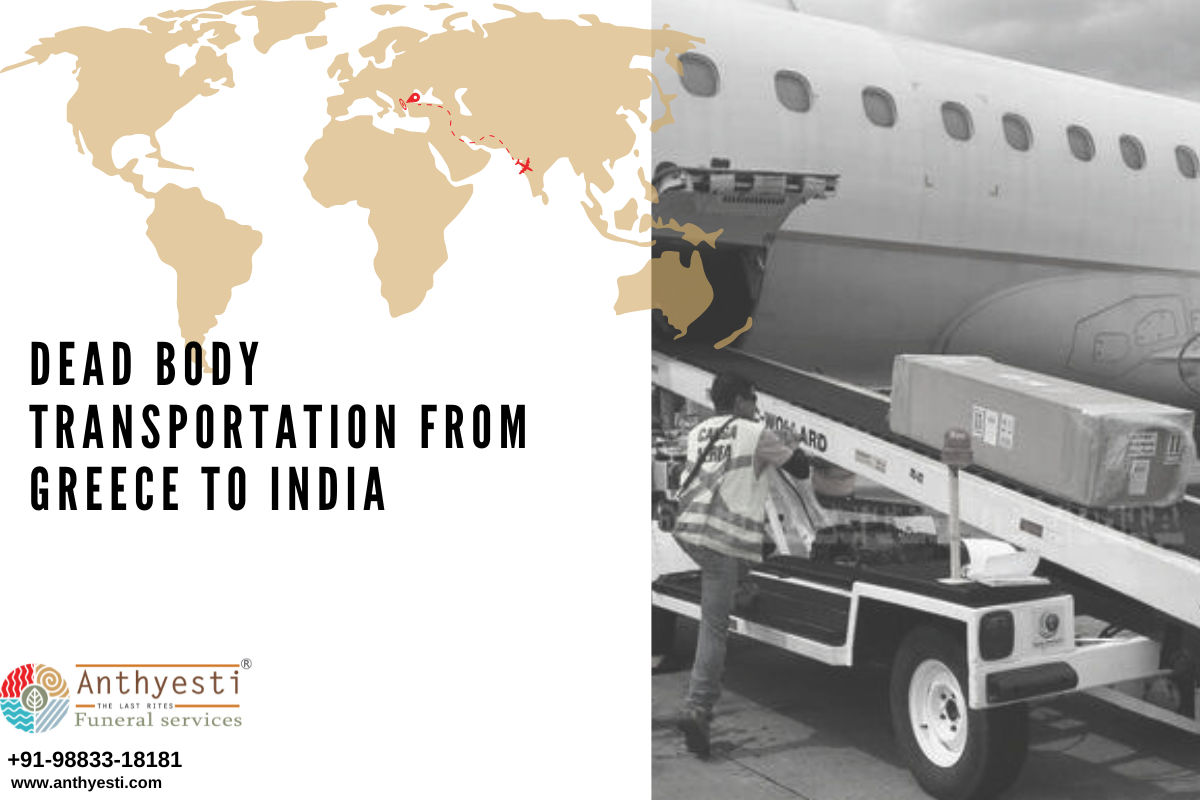
Losing a loved one in a foreign country is devastating. Repatriating a deceased family member from Greece to India involves navigating stringent Greek legal protocols, the Hague Apostille Convention requirements, and rigorous Indian Embassy documentation. We provide an expert, end-to-end service to bring your loved one home with dignity.
Key Overview
Essential Nuances of Repatriation from Greece
Transporting mortal remains from Greece back to India is exceptionally nuanced due to Greece’s strict adherence to EU health regulations and the Hague Convention on Apostilles. Unlike many other regions, you cannot simply present standard medical certificates to the Indian Embassy in Athens. Every local document must undergo rigorous translation and certification before clearance is granted.
⚠️ Emergency Contact: If a death has just occurred, immediately notify the Embassy of India in Athens. Emergency Phone: +30-6943556770. Address: 3, Kleanthous Street, 10674 Athens. Do not proceed with local funeral arrangements without their initial counsel.
Critical Greek Logistics
The process in Greece hinges upon two distinct paths: Natural vs. Unnatural death.
- Natural Deaths (Hospitals): Require a standard medical death certificate. However, this certificate MUST specifically state the cause of death.
- Unnatural Deaths (Accidents/Sudden): Will inevitably involve the Hellenic Police (Elliniki Astynomia) and a mandatory autopsy at a state forensics laboratory. This drastically extends the timeline, as Police Clearance is required before any further steps.
Greek Authority Documents
- Original Greek Death Certificate: Issued by the local registry (Lixiarheio).
- Medical Cause of Death: Issued by the attending doctor or forensic examiner.
- Non-Communicable Disease Certificate: Vital proof that the deceased did not harbor infectious diseases.
- Apostille & Translation: All Greek documents MUST be translated into English by a certified translator and bear the Apostille stamp from the Greek Ministry of Foreign Affairs.
Indian Embassy & Transport Documents
- Cancelled Indian Passport: The original passport must be surrendered to the Embassy for physical cancellation.
- No Objection Certificate (NOC): The master clearance issued by the Indian Embassy.
- WHO Embalming Certificate: Certification of high-grade preservation.
- Hermetic Sealing Certificate: Proof the zinc coffin is airtight.
- Air Waybill (AWB): Cargo booking via airlines like Emirates, Qatar Airways, or Etihad.
Medical Standards
Embalming and Coffin Regulations (WHO Standards)
International aviation law strictly governs how human remains are packaged for flight. Greece strictly enforces World Health Organization (WHO) protocols for embalming and caskets.
| WHO Embalming | The body must undergo arterial embalming using medical-grade formaldehyde solutions to ensure preservation during transit and prevent any public health hazards. A licensed Greek mortician must issue an Embalming Certificate. |
| Zinc-Lined Coffin | The body cannot be placed in a standard wooden box. It must be sealed inside a hermetic (airtight) zinc liner. This zinc liner is then securely placed inside a solid wooden outer casket. |
| Sealing Certificate | A Greek health or customs official will inspect the sealed coffin and issue a Sealing Certificate, confirming it meets IATA regulations. |
| Cargo Airlines | Airlines such as Emirates (via Dubai), Qatar Airways (via Doha), and Etihad (via Abu Dhabi) are the primary carriers handling Human Remains (HUM) cargo from Athens to India. |
Frequently Asked Questions (FAQ)
What is the very first step when a death occurs in Greece?
The absolute first step is to report the death to the local Greek police (in cases of unnatural death) or hospital authorities to obtain the initial medical death certificate. Simultaneously, contact the Embassy of India in Athens (+30-6943556770) to register the death and initiate the No Objection Certificate (NOC) process.
How long does it take to repatriate a dead body from Greece to India?
Under normal circumstances (natural death in a hospital), repatriation from Greece to India takes approximately 4 to 7 working days. If the death is unnatural, requires an autopsy, or involves a police investigation, the process can take 2 to 4 weeks depending on clearance from Greek judicial and police authorities.
What is an Apostille, and why is it required for repatriation from Greece?
Greece and India are members of the Hague Apostille Convention. Therefore, any official Greek document (like the Death Certificate or Police Clearance) must be ‘Apostilled’ (a specific form of international notarization) by the Greek Ministry of Foreign Affairs before the Indian Embassy will accept it for issuing the NOC.
Do documents need to be translated from Greek to English?
Yes, absolutely. The Indian Embassy in Athens and airport authorities in India require all Greek documents (Medical Certificate, Police Report) to be officially translated into English by a certified translator approved by the Greek Ministry of Foreign Affairs prior to Apostille and submission.
What are the WHO embalming standards for international transport?
The World Health Organization (WHO) mandates that the body must be heavily embalmed to prevent decomposition and infection during transit. The remains must be sealed in a zinc-lined, hermetically sealed inner casket, which is then placed inside a solid wooden outer coffin. An Embalming Certificate must be issued confirming this standard.
What happens to the deceased’s Indian passport in Greece?
The deceased’s original Indian passport must be surrendered to the Embassy of India in Athens. The Embassy will physically cancel the passport by punching holes in it and stamping it as ‘Cancelled due to death of the holder’ before returning it with the NOC. It must accompany the body to India.
What is a Non-Communicable Disease Certificate?
This is a mandatory health document issued by Greek medical authorities certifying that the deceased did not die from a contagious or communicable disease (like COVID-19, Ebola, etc.). It is required by airlines for cargo acceptance and by the Airport Health Officer (APHO) upon arrival in India.
Which airlines transport dead bodies from Greece (ATH) to India?
Major carriers operating from Athens International Airport (ATH) to major Indian hubs (DEL, BOM, BLR) that accept human remains cargo include Emirates (via Dubai), Qatar Airways (via Doha), Etihad Airways (via Abu Dhabi), and sometimes direct charter flights depending on the season.
Who handles customs clearance when the body arrives in India?
Customs and APHO (Airport Health Office) clearance in India is handled by the receiving family or a local funeral service provider like Anthyesti. Original documents (NOC, Cancelled Passport, Embalming Certificate) must travel with the cargo Air Waybill to facilitate this clearance at the destination airport.
Can the Indian Embassy provide financial assistance for repatriation?
Yes, in cases where the deceased was destitute or the family genuinely cannot afford the repatriation costs, the Embassy of India in Athens may provide financial assistance through the Indian Community Welfare Fund (ICWF). This is strictly subject to the Embassy’s assessment of the family’s financial status.
Need Urgent Assistance for Repatriation from Greece?
Our international repatriation experts are available 24/7 to guide you through the complex Greek legal system, embassy documentation, and flight logistics to bring your loved one home securely.
Expert Support
Global Network
We manage translations, Apostilles,
Embassy NOCs, and Air Cargo bookings.